1999 - year of foundation

200+ customers

100% post-payment

150+ existing contracts

DRAFT LABOR CODE

The Draft Labor Code of Ukraine (Bill No. 14386), initiated by the Cabinet of Ministers of Ukraine, is an attempt to “reassemble” labor rules for the realities of the 2020s and move them away from the logic of the Labor Code (KzPP) of 1971. The idea is not to rewrite everything for the sake of rewriting, but to codify modern employment formats, make norms predictable, and reduce legal uncertainty in daily HR processes and labor disputes.

The Government and the Ministry of Economy, Trade and Agriculture of Ukraine report that the draft was prepared in a format of social dialogue and is aimed at approximating European Union standards through the implementation of over 30 directives (working time, transparent and predictable working conditions, work-life balance, occupational safety, etc.).

For the employee, this means clearer rules of the game and protection mechanisms, and for the employer — more understandable procedures and fewer “grey areas” that often end in prescriptions, fines, and courts.

Among the innovations declared by the draft:

  • digitalization of labor relations (electronic documents are equated to paper ones, and an employment contract can be concluded in electronic form);
  • systematization and expansion of types of employment contracts to legalize work formats that are already in use;
  • introduction of signs of labor relations to distinguish them from civil law constructions and reduce the shadow economy;
  • a more transparent approach to determining the minimum wage in monthly and hourly dimensions with a calculation formula consistent with international approaches;
  • transition of labor inspection to a risk-oriented model with a focus on preventing violations and protecting the life and health of employees.

Procedurally, the bill was registered in the Verkhovna Rada of Ukraine on 15.01.2026, and the Committee of the Verkhovna Rada of Ukraine on Social Policy and Protection of Veterans’ Rights recommended on 04.02.2026 to include it in the agenda and adopt it as a basis in the first reading.

Next — amendments between the first and second readings and the final vote.

That is, for now, this is a draft, not a direct-action norm: until it enters into force, current acts apply, in particular the KzPP and special laws.

Practical advice to the employer is simple:

Do not wait for “Day X”, but conduct an inventory of HR processes and documents right now (contract templates, working time accounting, remote/flexible work rules, electronic document management, occupational safety).

Then the transition, when it happens, will be manageable — without “urgent for yesterday” and without unnecessary risks.

Updated Rules for Unscheduled Inspections: What Changed and Where the Employer is at Risk

CMU Resolution No. 303 dated 13.03.2022 introduced a moratorium on most state supervision (control) measures during martial law.
However, CMU Resolution No. 121 dated 28.01.2026 did not “cancel inspections” but rewrote the exceptions: scheduled and unscheduled measures generally remain suspended, but the list of grounds for unscheduled inspections has become broader and more detailed.

That is, it is no longer a “total pause,” but a regime of selective control.

BASIC GROUNDS THAT WORKED BEFORE:

  • court decision;
  • application of the business entity for an inspection “at its own request”;
  • verification of compliance with a prescription/order issued based on the results of a previous measure.

NEW/CLARIFIED EXCEPTIONS WHEN AN UNSCHEDULED INSPECTION IS POSSIBLE:

  • instruction of the Prime Minister of Ukraine in connection with systemic violations and/or an event with a significant negative impact on human rights, the environment, or state security;
  • presence of a threat to life or health, the environment, or state security;
  • fulfillment of Ukraine’s international obligations;
  • accident, fire, death, or severe accident/occupational disease related to the enterprise’s activity;
  • verification of license conditions when the threat is documentarily confirmed by an authorized body;
  • by decisions of bodies shaping state policy in the relevant sphere.

In parallel, the “corridor” of spheres where control measures are allowed has been expanded: from regulated prices and consumer rights protection (including utilities) and food/veterinary safety — to subsurface use, land control, and retail trade in medicines and medical devices.
For business, this means: risks can come not only from a “classic” inspection but also from adjacent regulators.


WHAT DOES THIS MEAN FOR HR AND OCCUPATIONAL HEALTH AND SAFETY?

In focus are three triggers for the employer: unfulfilled prescriptions, employee complaints citing danger, and accidents. In these situations, the “moratorium” does not save: control becomes targeted and legally tied to a specific event.

Advice: Conduct an Internal Audit Before They Come with a “Referral”

Check: formalization of labor relations, orders/timesheets, briefings, medical examinations, OHS training, logs, investigation/accounting of accidents, as well as the actual fulfillment of issued prescriptions.

And remember the “umbrella” of Law No. 877: during an unscheduled measure, controllers must verify only the issues that became its basis (and they must be specified in the referral).

The employer has the right not to admit an inspector without a service ID and a properly executed referral, as well as if a copy of the referral was not handed over before the start of the measure.

And if they try to check “everything at once” — remind them: an unscheduled measure = only specific questions.

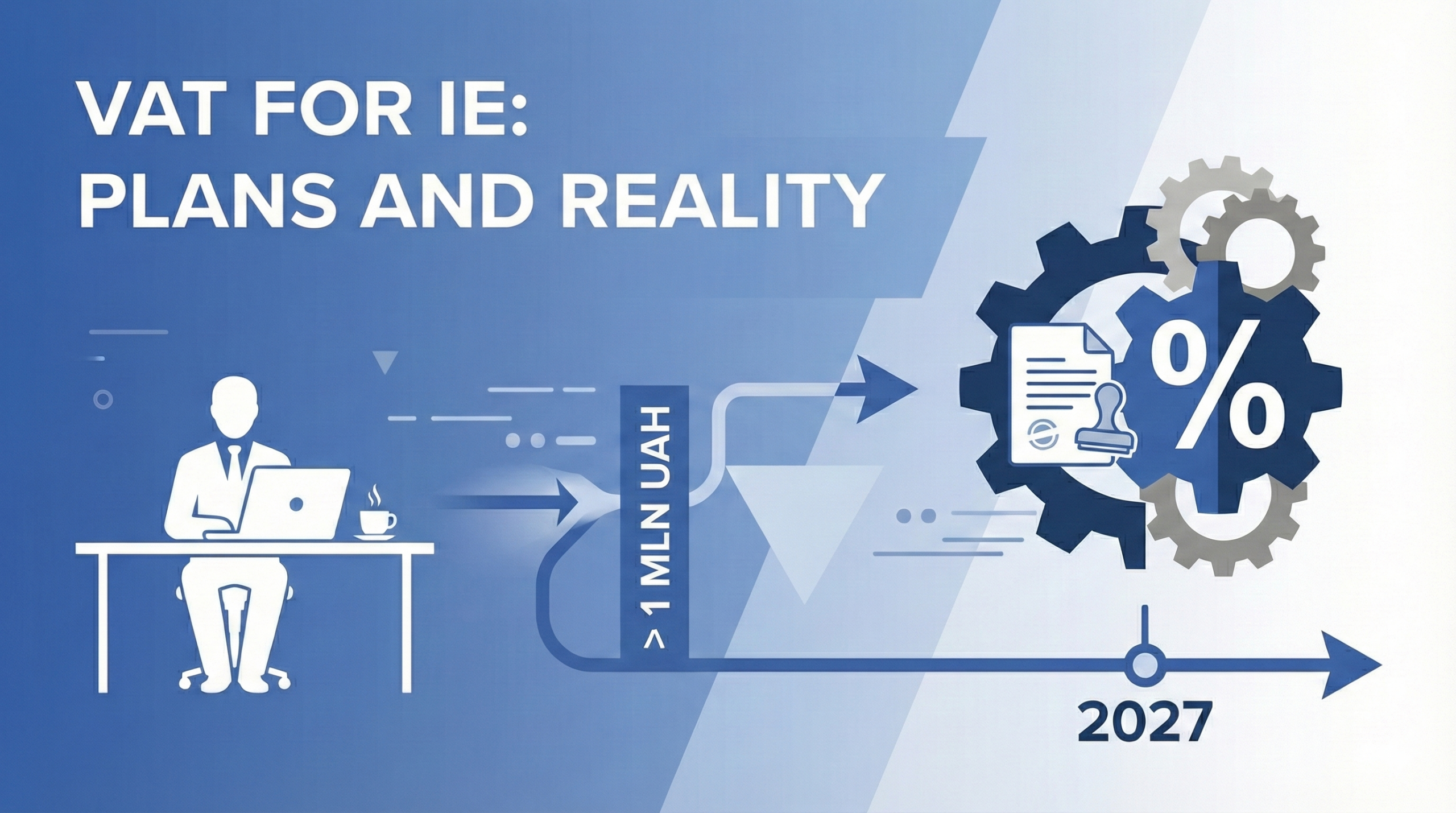
VAT for Group 1–3 IE/PE (FOP): New Draft Law, State Plans, and Real Situation

Recently, the topic “all FOPs on the simplified system will be forced to pay VAT” has been discussed again in entrepreneurial communities and social networks. Additional excitement was added by the fact that on December 18, 2025, the Ministry of Finance published a draft law regarding VAT for single tax payers.
Let’s calmly figure out what is already official, what is currently only a plan, and what FOPs should expect in the coming years.

What Is Important to Know Now

As of the end of 2025, the situation is as follows:

  • The Ministry of Finance has indeed prepared and submitted for public discussion a draft law on the mandatory registration of single tax payers as VAT payers.
  • The draft was developed with a view to launching new rules from January 1, 2027.
  • At this moment, this is not yet a valid law, but only a proposal that must be considered, finalized, and voted on in the Verkhovna Rada.
  • In 2025–2026, the rules for Group 1–3 FOPs regarding VAT do not change – simplifiers, as before, enjoy the privilege and are not obliged to become VAT payers, even if they exceed an income of UAH 1 million.

That is, for now, this is an announced direction of reform, and not “everyone transferred to VAT tomorrow.”

Why the Idea of VAT for Simplifiers Appeared at All

Ukraine is gradually aligning its tax system with European approaches and fulfilling obligations to international partners. The National Revenue Strategy until 2030 provides for:

  • gradual reduction of tax benefits for the simplified system;
  • expansion of the VAT tax base;
  • fighting situations where large or “almost large” businesses operate through FOPs on the simplified system without VAT.

It is in this context that the idea appears: if a simplifier exceeds a certain turnover volume, they must work according to the general VAT rules, like other business entities.


What the Ministry of Finance Draft Law Proposes

The Ministry of Finance published a draft law with a long technical name on amendments to the Tax Code regarding the registration of single tax payers as VAT payers. In essence, it is about the following.

The proposed norms apply to:

  • FOPs of groups 1, 2, and 3 on the single tax;
  • legal entities – payers of the single tax.

The draft law “pulls” simplifiers to the general rules: if over the last 12 months the volume of taxable operations for the supply of goods or services exceeded UAH 1 million (excluding VAT), an obligation arises to register as a VAT payer.

Important point: the calculation includes not only “classic” sales but also online activity – sales through websites, mobile applications, marketplaces, etc.

If maximally simple:

  • it is proposed to remove the exception from the Tax Code norms for single tax payers of groups 1–3 regarding mandatory VAT registration when exceeding the threshold of UAH 1 million;
  • a separate norm establishes that for simplifiers of groups 1–3, the general VAT threshold applies on the same conditions as for other payers;
  • for group 3, the use of rates of 5% (without VAT) and 3% (with VAT) and the transition procedure if the entrepreneur received the status of a VAT payer are clarified.

For FOPs falling under mandatory VAT registration, additional requirements appear:

  • introduction of more detailed accounting of income and expenses in the prescribed form;
  • regular submission of VAT reporting and tax payment according to all rules, as for other payers.

That is, the simplified system remains, but the level of formalization and accounting for part of FOPs will increase significantly.

When New Rules Might Start Operating

According to the logic arising from the explanatory materials to the draft law and Ukraine’s financial obligations:

  • End of 2025 – the draft law was submitted for discussion;
  • 2026 – submission to parliament, consideration, and voting are expected;
  • January 1, 2027 – the date from which they plan to put the new rules into effect (if the law is adopted and signed).

That is, even under an optimistic scenario for the state, entrepreneurs have at least a year to prepare.


What VAT Rules Apply to FOPs Now (2025–2026)

To understand the scale of changes, it is important to fix the starting point.

Currently:

  • There is a general rule in the Tax Code: when exceeding UAH 1 million of taxable turnover in 12 months, a business entity must register as a VAT payer.
  • Single tax payers of groups 1–3 have a special privilege – this requirement does not apply to them now.
  • FOPs of groups 1 and 2 do not register as VAT payers at all while the current version of the code is in effect.
  • FOPs of group 3 can work:
    • either at a rate of 5% without VAT;
    • or at a rate of 3% + VAT, if they voluntarily decide to register as a VAT payer or are obliged to do so on general grounds.

And most importantly: exceeding an income of over UAH 1 million by a FOP of group 1–3 in itself does not yet create an obligation to become a VAT payer until the law is changed.

What This Means for FOPs in Practice

Today the situation looks like this:

  • In 2025–2026, FOPs of groups 1–3 work according to already familiar rules – no “new VAT” specifically for simplifiers has been introduced.
  • FOPs of groups 1–2, as before, do not become VAT payers.
  • FOPs of group 3 can independently decide whether to work with VAT (3% + VAT) or without it (5%), based on the structure of their clients and expenses.

How to Prepare for Possible Changes Without Panic

A rational strategy for an entrepreneur now is not to be nervous, but to plan:

  1. Follow the fate of the draft law
    Subscribe to news from the Ministry of Finance, the State Tax Service, and specialized accounting resources – so as not to miss the moment when the project is submitted to the Rada and in what form it is adopted.
  2. Analyze your turnover
    If you are steadily approaching UAH 1 million per year or exceeding this amount, it is worth calculating in advance how a possible transition to VAT will affect prices, cost, and profit.
  3. Review the model of working with clients
    For those who work mainly with large companies, VAT is often not a problem – on the contrary, it is even more convenient for counterparties. Perhaps a voluntary transition to VAT even before the changes will be a profitable step for you.
  4. Consult with specialists
    Everyone has their own individual situation: someone works in retail, someone in B2B or IT. Therefore, before changing the taxation model, it is better to discuss options with an accountant or tax consultant.

Conclusion: We Work as Before Now, But Look to 2027

Today it is important to fix several theses:

  • Yes, the state has a clear intention to tie FOPs of groups 1–3 to general VAT rules through a turnover threshold of UAH 1 million.
  • Yes, there is already a specific draft law from the Ministry of Finance published for discussion.
  • No, this law is not yet in effect, and until January 1, 2027, no automatic changes for simplified FOPs have been launched.

As of the end of 2025, there are no grounds for panic decisions – there is time to calmly prepare, follow the news, and calculate scenarios for your business.

The material is for informational purposes only and is not individual tax or legal advice. To make decisions regarding your business, we recommend contacting a professional consultant.


Group 3 Individual/Private Entrepreneurs (FOP) in 2026: New Limits and Total Tax Burden

From January 1, 2026, working conditions for Group 3 FOPs are also changing. Although the percentage rates of the Single Tax remain unchanged, the total financial burden will increase due to the rise in the minimum wage (to UAH 8,647).

1. Income Limit

The annual limit for the third group increases significantly and will amount to UAH 10,091,049.

Tax Details (Single Tax, ESV, Military Levy)

For Group 3, the key factors are percentage rates based on turnover and the fixed ESV.

Payment Type Rate Payment Amount
Single Tax 5% (non-VAT)
or 3% (+ VAT)
% of income
Military Levy 1% of income % of income
ESV
(Social Contribution)
22% of Min. Wage UAH 1,902.34/mo
(UAH 22,828.08/year)

Tax Burden Formula

For a Group 3 FOP (non-VAT payer), the estimated expense scheme for 2026:

UAH 22,828.08 (ESV)
+
6% of annual income

(5% Single Tax + 1% Military Levy)

What Entrepreneurs Should Do

  • Recalculate expenses: Evaluate whether it is profitable for you to remain in Group 3, considering the increase in ESV and the Military Levy.
  • Evaluate VAT: If your main counterparties are VAT payers, it may make sense to switch to the 3% + VAT rate.
  • Monitor the limit: The new limit of over UAH 10 million opens up more opportunities for business scaling without switching to the general taxation system.
Interesting Facts
THE FASTEST RECRUITMENT PROJECT

Just 3 calls, 2 candidates — and an agreed start of work in 30 minutes.

30

Minutes

THE LARGEST OUTPLACEMENT PROJECT

120 specialists received support after being laid off.

120

Specialists

THE LARGEST OUTSTAFFING PROJECT

3,700 specialists in Ukraine worked on the solar power plants project.

3,700

Specialists

THE LONGEST CUSTOMER COOPERATION

The contract has been in place for 21 year and is still active.

21

Year

RECRUITMENT TEAM BEFORE THE CRISIS

25 recruiters were closing up to 600 applications per year.

600

Applications/year

WOMEN'S TEAM

95% of the Ukrainian team are female.

95%

Women

CUSTOMER RETURNS

Customers who chose cheaper competitors return in 1–2 years.

1–2

Years

NO CUSTOMER LOSS DUE TO POOR QUALITY

In 25 years, not a single customer has been lost due to non-fulfillment of obligations.

0

Customer Losses

OUTSTAFFING MARKET CONCENTRATION

14 companies serve 95% of the market, two of them serve half.

14

Main players

ON-GOING PROMOTION PROJECTS

150+ active outstaffing/outsourcing projects in Ukraine.

150+

Projects

RECRUITMENT CONTRACTS

More than 100 active contracts for recruitment services.

100+

Current contracts

HIGHEST DAILY RATE

An offshore drilling rig safety engineer earned the highest daily wage.

1,200,00

Pounds/day