
1999 - year of foundation

200+ customers

100% post-payment

150+ existing contracts

Independent Analysis of the Draft Labor Code of Ukraine by the Tony Blair Institute

The new Labor Code of Ukraine currently remains just a draft, but the discussion around it has already gone far beyond purely legal technique. Additional significance was given to this discussion by the White Paper prepared by the Tony Blair Institute. According to the Ministry of Economy, the document contains an independent analysis of the key provisions of the draft and their potential impact on the labor market, economy, and the system of labor relations. In this context, the White Paper should be perceived not as a source of law, but as analytical material that evaluates how the proposed model of labor regulation meets modern challenges, in particular, reconstruction, de-shadowing of employment, and European integration.

Key Conclusion of the Analysis

The key conclusion of the analysis is that the draft Labor Code is considered as an attempt to replace fragmented labor regulation with a more holistic and predictable system of rules. The Ministry of Economy, referring to the White Paper, notes: if properly implemented, the cumulative effect of the reform could amount to:

  • about 302 thousand formalized or new formal jobs and
  • approximately UAH 43.4 billion of net fiscal effect per year.

This means that the document evaluates the reform not only from the point of view of workers’ rights, but also as a tool for economic recovery and expansion of the formal sector.

Basic Labor Guarantees

A separate block of conclusions concerns basic labor guarantees. According to data published by the Ministry of Economy, the authors of the White Paper positively evaluate the approach under which the minimum wage in the draft should gradually approach 50% of the average wage in the economy, and also be determined in monthly and hourly dimensions.

In addition, the draft provides for an increase in the minimum annual paid leave from 24 to 28 calendar days.

Here it is important not to confuse the draft and the current law: today the minimum wage is already established simultaneously in monthly and hourly amounts, and the annual basic leave, as a general rule, is not less than 24 calendar days. Thus, the novelty of the draft lies not in the very fact of the hourly and monthly dimension of the minimum wage, but in the new logic of its determination and in raising the leave standard.

Family Policy and Women’s Participation

Significant attention in the analysis is paid to family policy and women’s participation in the labor market. The White Paper positively evaluates the norm on an additional four months of parental leave for each child, of which two months are an individual right of each parent and cannot be transferred.

According to the given estimates, such an approach can yield about 86 thousand people of additional net employment and approximately UAH 7 billion of annual net benefit for the state. From a legal point of view, this shows an attempt to shift the focus from a formal declaration of guarantees to a real combination of work and family responsibilities, which corresponds to the European approach to work-life balance. At the same time, such changes themselves are not yet a current norm, but belong to the predicted effect of the possible adoption of the draft.

De-shadowing, Inspections, and Digitalization

Another strong block of analysis concerns the de-shadowing of employment, the inspection model, and the digitalization of labor processes.

  • The White Paper notes that a risk-oriented and institutionally independent labor inspection can stimulate the transition of 110 to 210 thousand jobs into the formal sector and provide UAH 9-19 billion of additional revenues annually.
  • Separately, the recognition of the electronic written form of the employment contract and full-fledged electronic document management is positively evaluated, which, according to calculations, can give businesses about UAH 226 million of direct administrative savings per year.

For the Ukrainian labor market, this is especially important, since the digitalization of labor relations is capable of shortening processing times, reducing the number of disputes, and lowering the administrative burden on the employer.

Inclusivity and New Groups in the Labor Market

The document also positively evaluated the block of decisions related to inclusivity and the entry of new groups into the labor market. It refers, in particular, to the student employment contract, which is supposed to formalize the combination of study with work and create a more understandable path to the first official employment.

Under a conservative scenario, this could yield about 56 thousand additionally formalized employees and approximately UAH 3.4 billion in tax revenues annually. The White Paper also draws attention to the agreed provisions regarding non-discrimination and support for veterans. In a legal sense, this indicates an intention to form not just a new code, but a framework that covers a broader spectrum of social and labor risks than the current fragmented regulatory system.

Predictability of Rules and Dispute Resolution

Special attention should be given to the conclusion regarding the predictability of rules for employees and businesses. The authors of the analysis emphasize that the draft can replace fragmented regulation with new standards, including the electronic written form, clearer rules regarding the minimum wage and vacations, as well as labor arbitration.

According to the document’s assessment, in the case of widespread use of arbitration, the total annual savings for employees and employers could reach UAH 5.3 billion, and the additional effect for the efficiency of the justice system — about UAH 970 million. This block is important precisely for business, because it shows: it is not only about expanding guarantees, but also about attempting to make labor rules more predictable, and dispute resolution methods — less costly in time and resources.

Overall, the independent analysis of the Tony Blair Institute forms a positive, but not unconditional, assessment of the draft Labor Code of Ukraine. The document considers it as a step towards harmonization with the EU acquis, towards strengthening consistency with EU and ILO standards, and towards creating a more cohesive system of labor rules.

At the same time, the main legal conclusion follows from the very logic of the analysis: the expected effect is possible only subject to high-quality implementation, the adoption of necessary sub-legislative acts, and proper institutional support. Therefore, today the White Paper is a significant argument in the professional discussion about the reform, but it does not replace the current labor legislation of Ukraine, which continues to apply until the moment of the adoption of the new code.


Update on Re-reserving Employees in “Diia”: What Changed for Critically Important Enterprises

For critically important enterprises, a simplified extension of employee reservation has started working in “Diia”. The main change consists in the fact that in the presence of an active reservation, it is no longer necessary to first cancel the previous status and only then submit a new application. If the body that granted the enterprise the critically important status has not changed, and the employee’s reservation is still valid, the extension occurs seamlessly. According to the “Diia” portal, such an application is processed within 24 hours.

In fact, this concerns electronic re-reservation without an administrative pause between the previous and new status. This is important for employers, because previously the need to first cancel the active reservation created a risk of a temporary gap in processing. Now the “Extension of employee reservation” service allows avoiding this problem and maintaining the continuity of reservation for key specialists.

Legal entities and their separate subdivisions can use the service if they are included in the List of companies for the reservation of persons liable for military service on the “Diia” portal. The head, a signatory according to the Unified State Register (EDR), or an authorized person has the right to submit an application.

The procedure looks like this:

  • authorization on the portal using an electronic signature,
  • selection of the “Extension of employee reservation” service,
  • verification of company data,
  • adding employees,
  • signing the application with a QES (Qualified Electronic Signature).

If the application is submitted by an authorized person, it must be signed by the head of the enterprise.

At the same time, the simplified mechanism does not work in all cases. “Diia” explicitly states that it is possible to re-reserve only those employees who have an active reservation under the previous decision on criticality, and only on the condition that the validity period of criticality has been extended.

If the reservation has already expired, the employee is not employed in this company, is absent from the Register of persons liable for military service, or the state body that determined the enterprise as critically important has changed, the usual reservation procedure applies, not an extension.

The legal basis for this update is the Cabinet of Ministers of Ukraine Resolution No. 76 dated 27.01.2023. In the current wording of the Reservation Procedure, paragraph 29 stipulates: for persons liable for military service who work at critically important enterprises or in critically important institutions, subject to confirmation of such status and an unexpired reservation period, reservation is carried out without taking into account the period specified in the first subparagraph of this paragraph. Thus, the new service in “Diia” does not create a new rule, but implements the mechanism already enshrined in the Procedure in a convenient electronic format.

As of March 2026, this update is a practical tool for businesses that have a confirmed critically important status. It reduces processing time, decreases the number of technical actions, and helps avoid situations where an employee’s reservation could “hang” due to unnecessary bureaucracy.

Legally, the key condition remains the invariability of the reservation grounds: the employee’s active status, the enterprise’s active criticality, and the absence of a change in the body that confirmed it.

Can an Employee Wanted by the TCC Be Hired: Explanation from the State Labor Service

An employer can conclude an employment contract with a person liable for military service who is wanted for violating military registration rules, but only under certain conditions.

The State Labor Service was asked: Does an employer have the right to hire a person who is wanted for violating military registration rules?

Yes, they do, provided the employer is classified as an enterprise, institution, or organization that is critically important for ensuring the needs of the Armed Forces of Ukraine, other military formations created in accordance with the laws of Ukraine, or the functioning of the economy and ensuring the livelihood of the population in a special period in the sphere of the defense-industrial complex.

Corresponding changes were made to the Law of Ukraine dated 15.03.2022 No. 2136-IX “On the Organization of Labor Relations Under Martial Law” (hereinafter – Law No. 2136).

In particular, Article 2 of Law No. 2136 was supplemented with a third part.

Thus, it is provided that when concluding an employment contract with military-liable employees at enterprises, institutions, and organizations that are critically important for ensuring the needs of the Armed Forces of Ukraine, other military formations created in accordance with the laws of Ukraine, or the functioning of the economy and ensuring the livelihood of the population in a special period in the sphere of the defense-industrial complex, the probation period upon hiring cannot exceed 45 calendar days for any category of employees.

In order to promptly involve new employees in the performance of work, as well as to eliminate personnel deficits and labor shortages, such enterprises, institutions, and organizations have the right, during the probation period upon hiring, to conclude employment contracts with military-liable employees:

  • • who lack or have improperly processed military registration documents;
  • and/or
  • • who are not on military registration;
  • and/or
  • • who have not updated personal data specified in subparagraph 1 of paragraph 2 of section II “Final and Transitional Provisions” of the Law of Ukraine dated 11.04.2024 No. 3633–IX “On Amendments to Certain Legislative Acts of Ukraine Regarding Separate Issues of Military Service, Mobilization and Military Registration”;
  • and/or
  • • who are wanted for violation of military registration rules, legislation on defense, mobilization preparation and mobilization.

In this case, it will not be considered a violation by officials of enterprises, institutions, and organizations of the legislation on defense, mobilization preparation, and mobilization.

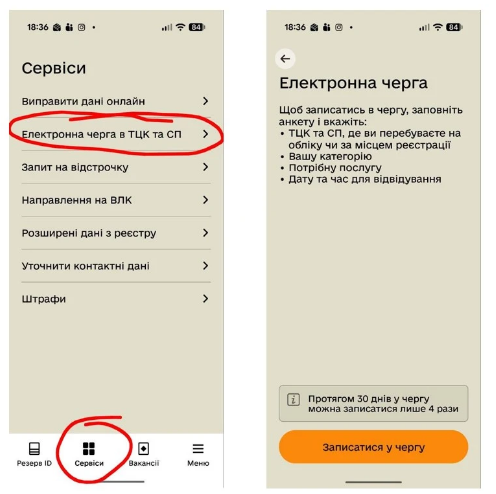
Electronic Queue to TCC Is Now Available in “Rezerv+”

Persons liable for military service, conscripts, and reservists can sign up for territorial recruitment and social support centers through the “Rezerv+” mobile application. The electronic appointment allows choosing the date and time of the visit, tracking one’s queue, and receiving reminders about the appointment.

The Ministry of Defence reported that persons liable for military service, conscripts, and reservists can now plan a visit to the territorial recruitment and social support centers through the “Rezerv+” mobile application.

The electronic queue to the TCC allows users to:

  • choose a convenient date and time for a visit in a few clicks on a smartphone;
  • avoid standing in lines;
  • see their number in the queue, the selected service, and the status of the appointment;
  • cancel the appointment or leave feedback;
  • receive reminders in the form of push notifications.

At the same time, the service helps TCC employees better plan their work: all appointments are formed in one list, queues decrease, and service becomes more organized and transparent.

To use the service, it is necessary to:

  1. Update the application to version 2.0.0.
  2. In the “Services” section, select “Electronic queue to TCC.”
  3. Specify the TCC, the reason for the visit, date, and time.
Rezerv+ app screenshot showing Electronic Queue
Interesting Facts
THE FASTEST RECRUITMENT PROJECT

Just 3 calls, 2 candidates — and an agreed start of work in 30 minutes.

30

Minutes

THE LARGEST OUTPLACEMENT PROJECT

120 specialists received support after being laid off.

120

Specialists

THE LARGEST OUTSTAFFING PROJECT

3,700 specialists in Ukraine worked on the solar power plants project.

3,700

Specialists

THE LONGEST CUSTOMER COOPERATION

The contract has been in place for 21 year and is still active.

21

Year

RECRUITMENT TEAM BEFORE THE CRISIS

25 recruiters were closing up to 600 applications per year.

600

Applications/year

WOMEN'S TEAM

95% of the Ukrainian team are female.

95%

Women

CUSTOMER RETURNS

Customers who chose cheaper competitors return in 1–2 years.

1–2

Years

NO CUSTOMER LOSS DUE TO POOR QUALITY

In 25 years, not a single customer has been lost due to non-fulfillment of obligations.

0

Customer Losses

OUTSTAFFING MARKET CONCENTRATION

14 companies serve 95% of the market, two of them serve half.

14

Main players

ON-GOING PROMOTION PROJECTS

150+ active outstaffing/outsourcing projects in Ukraine.

150+

Projects

RECRUITMENT CONTRACTS

More than 100 active contracts for recruitment services.

100+

Current contracts

HIGHEST DAILY RATE

An offshore drilling rig safety engineer earned the highest daily wage.

1,200,00

Pounds/day